
Mental Health Reimbursement Rates 2026: Complete Provider Guide
Last Updated: December 2025 | Next Review: March 2026
QUICK REFERENCE:
Whats New for 2026 | Medicare Reimbursement for 2026 | 2026 Rates by Payer | Factors that Influence Reimbursement |
What Reimbursement Looks Like In Practice | What Insurance Companies Pay | Essentials CPT Codes for Mental Health | 7 Strategies to Maximize Reimbursement | LMFT & LMHC Billing Opportunities | Telehealth Reimbursement | Credentialing and Panel Management | Value-Based Care and Outcome Tracking | Common Billing Challenges | Tools and Technology to Optimize Reimbursement | FAQ | How Behave Health Helps Maximize Reimbursement
Insurance reimbursement can make or break a mental health practice. In 2026, therapists, psychologists, social workers, and mental health clinics face a shifting landscape: Medicare rates are recovering from 2025 cuts, value-based care is expanding rapidly, and commercial payers are increasingly tying rates to outcomes and network participation. Understanding what each payer actually pays, and how to optimize billing, is essential to maximizing practice revenue while maintaining access to care.
This guide breaks down exactly what Medicare, Medicaid, and commercial insurers pay for common mental health services in 2026, which payers offer the best rates, how to negotiate better contracts, and how Behave Health’s EHR can help you track and maximize collections across all payers.

What's New for Mental Health Reimbursement in 2026
Medicare rate recovery: After ~14% cuts in 2025 (conversion factor dropped to $32.35), 2026 brings modest increases with conversion factor rising to $33.59 for MIPS/APM participants. Most psychotherapy codes see 2–4% increases over 2025.
LMFT/LMHC Medicare eligibility: Licensed Marriage and Family Therapists and Licensed Mental Health Counselors can now bill Medicare independently at 75% of psychologist rates—a major workforce expansion that took effect in 2024 and continues through 2026.
Telehealth parity is permanent: Medicare's telehealth flexibilities for behavioral health are now permanent, and most commercial plans have aligned in-person and telehealth reimbursement rates.
Value-based care expansion: CMS Innovation in Behavioral Health Model launched January 2025 in four states (CA, NY, TN, OR), and private payers are increasingly offering enhanced rates for collaborative care and outcome-based contracts.
Credential-based rate differentials growing: More commercial plans are tiering reimbursement by credential, with PhDs/PsyDs/MDs commanding 10–20% higher rates than master's-level clinicians for the same CPT codes
Medicare Reimbursement Rates for Mental Health: 2025–2026
Medicare remains the most standardized payer for mental health services. Rates are published annually via the Physician Fee Schedule and adjusted by geographic locality (typically adding 7–15% in high-cost areas like New York, San Francisco, and Boston).
2025–2026 Medicare Rates by CPT Code
| CPT Code | Description | 2025 Medicare Rate | Projected 2026 Rate* | Notes |
|---|---|---|---|---|
| 90791 | Psychiatric diagnostic evaluation | $174.35 | ~$178.50 | Billed once per episode; requires thorough intake documentation |
| 90832 | Individual psychotherapy, 30 minutes | $79.35 | ~$81.25 | Typically used for brief interventions or shorter sessions |
| 90834 | Individual psychotherapy, 45 minutes | $104.65 | ~$107.15 | Most common standard session length; highest-volume code |
| 90837 | Individual psychotherapy, 60 minutes | $154.29 | ~$158.00 | Premium rate for extended sessions; verify exact session length |
| 90847 | Family psychotherapy with patient | $103.65 | ~$106.10 | Includes patient in session; higher rates if co-occurring diagnosis addressed |
| 96130 | Psychological testing, first hour | $121.50 | ~$124.40 | Neuropsych and psychodiagnostic testing; add-on to eval |
| 96131 | Psychological testing, each additional hour | $86.75 | ~$88.85 | Document total testing hours precisely |
*2026 projections based on $33.59 conversion factor for MIPS Quality Payment Program participants and standard geographic multipliers.
Important notes:
Rates vary by locality. Add 7–15% in high-cost areas; subtract 5–10% in rural areas.
LMFT and LMHC providers receive 75% of these amounts (e.g., ~$115.72 for 90837 instead of $154.29).
Medicare pays 80% of allowed amount; patients responsible for 20% coinsurance (or secondary insurance covers it).
All rates assume non-facility setting (office-based practice). Hospital/facility rates are lower.
Commercial and Medicaid Reimbursement: 2025–2026 Rates by Payer
Commercial insurance typically pays more than Medicare, but varies dramatically by region, plan, and credential. Medicaid, by contrast, pays less than Medicare on average but is essential for patient access.
Top-Paying Commercial Payers for Mental Health (2025–2026)
| Insurance Company | 90837 Rate Range (60-min therapy) | Difficulty to Credential | Authorization Requirements | Key Notes |
|---|---|---|---|---|
| BCBS Illinois | $180–$210 | Moderate | Typically none for routine therapy | Highest-paying regional plan; requires extensive credentialing; strong network demand |
| BCBS Horizon (NJ) | $175–$195 | Moderate | Typically none for routine therapy | High rates in metro areas; moderate auth requirements |
| Premera (WA/AK) | $170–$190 | Easy | Minimal for therapy; varies by member plan | Competitive rates; faster credentialing than BCBS |
| Medicare | $154–$158 | N/A (national program) | Varies by MAC; generally straightforward | Standardized rates; complex billing rules for some scenarios |
| Kaiser Permanente | $165–$185 | Very difficult | Strict per-member-per-month authorization | Closed network; high rates but limited panel growth; lengthy approval |
| Aetna | $144–$160 | Easy | Minimal; some plans cap annual visits | Average rates; straightforward billing; competitive for volume |
| Cigna | $138–$155 | Easy | Minimal; good for high-volume agreements | Average rates; good options for volume negotiations |
| UnitedHealthcare/Optum | $135–$150 | Easy | Varies by plan; some require auth | Below-average rates but largest network; easiest to credential |
| Magellan (behavioral health carve-out) | $120–$135 | Difficult | Heavy authorization, especially for ongoing care | Lowest rates; carve-out administration can be cumbersome; consider carefully |
*Rates reflect credential differences (PhD/PsyD/MD at high end; master's-level at low end) and geographic variation. Ranges shown are national averages; local variations can be 10–25%.
Medicaid Reimbursement for Mental Health (2025–2026)
Medicaid is the single largest payer for mental health services in the U.S., covering millions of adults with behavioral health conditions. However, reimbursement is significantly lower than Medicare and commercial insurance, and varies dramatically by state.
Key facts:
Average Medicaid payment for psychiatry: ~70–80% of Medicare rates.
For example, if Medicare pays $154.29 for 90837, Medicaid might pay $108–123 in most states.
State variation is extreme: Some states (e.g., Illinois, California) have raised behavioral health rates in 2025; others remain stagnant.
Managed care dominance: Most states use Medicaid managed care organizations (MCOs) for behavioral health, which may negotiate slightly above or below the state fee schedule.
Why Medicaid matters despite lower rates:
Covers uninsured and low-income individuals who have no other insurance options.
Often required to accept as in-network provider in certain state regions.
Volume can offset lower per-session rates in high-capacity practices.
Factors That Influence Your Mental Health Reimbursement Rate
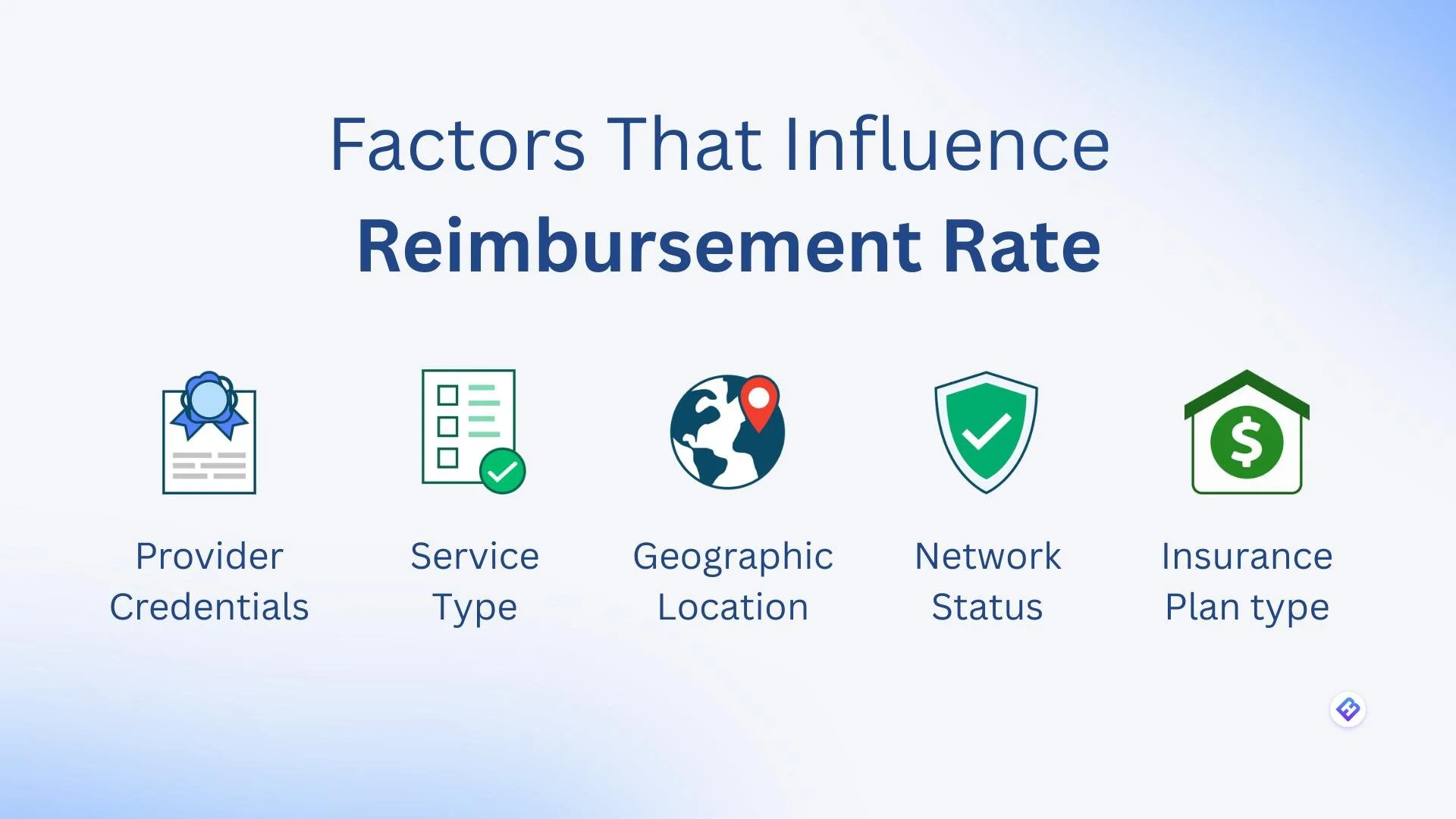
Understanding what drives your reimbursement helps you negotiate better contracts and position your practice strategically.
Provider Credentials
Higher credentials command higher rates across nearly all payers. Medicare and commercial plans tier reimbursement: PhD/PsyD/MD > Master's with licensure (LCSW, LPC, LMFT) > Unlicensed/lower credentials. Credential differentials of 10–25% are common.
Service Type
Specialized services (neuropsychological testing, psychiatric evaluations, intensive outpatient programs) often have higher reimbursement than standard psychotherapy. CPT codes like 96130 (psychological testing) and 90791 (comprehensive psych evaluation) reimburse at premium rates.
Geographic Location
Urban areas with higher cost-of-living and greater mental health demand typically reimburse 10–25% more than rural areas. Medicare explicitly adjusts rates by locality; commercial plans often do too.
Network Status (In-Network vs. Out-of-Network)
In-network providers have negotiated (often lower) rates but benefit from patient volume and direct payer payment. Out-of-network providers may cite higher chargemaster rates but face greater patient responsibility and billing challenges.
Insurance Plan Type
HMO, PPO, and EPO plans have different authorization and payment structures. HMOs typically reimburse lower but have larger networks; PPOs pay more but have stricter networks or authorization requirements.
What Medicare Reimbursement Looks Like in Practice
Let's walk through a real example to show how Medicare reimbursement actually works for a mental health practice.
Scenario: You are a licensed clinical social worker (LCSW) with a master's degree, seeing a 55-year-old Medicare patient for a 60-minute psychotherapy session for depression (90837).
CPT code: 90837
Medicare allowed amount (2025): $154.29
Your credential adjustment: You are master's-level; most Medicare payers pay LCSW rates equivalent to psychologist rates, though some plans pay slightly less. Assume 100% of psychologist rate for this example.
Actual Medicare payment: 80% of $154.29 = $123.43
Patient responsibility: 20% coinsurance = $30.86 (or secondary insurance covers it)
What you bill: Your chargemaster (full charge) might be $200–250, but Medicare limits you to $154.29. You must write off the difference.
For comparison:
BCBS Illinois (commercial): Might pay $185–200 for the same session
Medicaid (most states): Might pay $108–123
Uninsured patient (out-of-pocket): You set the rate, but many practices offer sliding scales or flat fees ($80–150)
This example shows why payer mix matters: a practice heavy in Medicare and Medicaid generates lower revenue per session than one with more commercial insurance.
Which Insurance Companies Pay the Most for Mental Health?
Highest-paying payers:
BCBS regional plans (especially Illinois, New Jersey, Massachusetts) – $180–210 for 90837
Premera (Pacific Northwest) – $170–190
Regional Blue Cross plans (varies by state) – $170–195
Medicare (standardized) – $154–158
Kaiser Permanente – $165–185 (but closed network)
Mid-range payers:
Aetna, Cigna, some Anthem plans – $138–160
Lower-paying payers:
UnitedHealthcare/Optum, Magellan – $120–150
Negotiation strategy:
If you're in-network with a low-paying plan (e.g., Magellan at $120–135 for 90837) but see high volume from that plan, use that volume as leverage to negotiate higher rates or consider dropping the plan if it significantly underperforms.
Essential CPT Codes for Mental Health Providers (2026)
Using the right CPT code is critical for accurate reimbursement. Here are the codes you'll use most frequently:
Initial Assessment Codes
90791 – Psychiatric diagnostic evaluation (without medical services): Used once per episode of care; includes comprehensive history, mental status exam, and treatment plan. Reimbursement: ~$174–178 Medicare, $160–190 commercial.
90792 – Psychiatric diagnostic evaluation with medical services (e.g., if an MD does the evaluation): Higher reimbursement than 90791. Reimbursement: ~$195–210 Medicare.
Individual Psychotherapy Codes (Most Common)
90832 – 30 minutes: Use for brief sessions or short interventions. Reimbursement: ~$79–81 Medicare.
90834 – 45 minutes: Standard session length; highest-volume code for most practices. Reimbursement: ~$104–107 Medicare.
90837 – 60 minutes: Extended sessions for complex cases. Reimbursement: ~$154–158 Medicare.
Important: Bill the code that matches your actual session length. Billing 90837 for a 50-minute session is upcoding and risks audits and recoupment.
Group and Family Codes
90853 – Group psychotherapy: One code per patient per session, regardless of group size. Reimbursement: ~$45–55 Medicare (lower than individual therapy).
90847 – Family psychotherapy with patient present: Use when family members attend and the focus is the patient's treatment. Reimbursement: ~$103–106 Medicare.
90846 – Family psychotherapy without patient present: Medicare rarely covers this; use 90847 instead for most cases.
Specialized/Advanced Codes
96130 – Psychological testing/evaluation, first hour: Neuropsych testing, psychodiagnostic testing. Reimbursement: ~$121–124 Medicare.
96131 – Psychological testing, each additional hour: Add-on code; bill for each hour beyond the first. Reimbursement: ~$86–88 Medicare.
90839 + 90840 – Psychotherapy for crisis: Premium rates for urgent, high-complexity sessions. 90839 is first 60 minutes (~$180–200 Medicare); 90840 is each additional 30 minutes (~$90–100 Medicare). Only use for true psychiatric crises.
Add-On Codes (Used with Other Services)
90833, 90836, 90838 – Can be added to evaluation codes or other services to capture psychotherapy time in integrated care settings.
Billing Tips:
Choose the code that matches your actual session length. If a session runs 50 minutes, 90834 (45 min) is more defensible than 90837 (60 min).
Do not bill multiple psychotherapy codes for the same patient on the same day to the same payer, as it may trigger denial for duplicate billing.
Different payers may have different requirements for which code to use; verify payer guidelines before billing.
How to Maximize Reimbursement: 7 Strategies
1. Benchmark Your Current Rates Against These Standards
Compare what each payer is actually paying you to the rates shown in this guide. If you're in-network with Aetna for $120 per 90837 session but the market average is $144–160, you have room to renegotiate—especially if you see high volume from that plan.
2. Prioritize In-Network Status with Top-Paying Payers
Join BCBS, Premera, and regional Blue Cross plans if available in your market. Higher per-session rates often offset the work of in-network credentialing.
3. Use Credential Differentials to Your Advantage
If you hold a PhD, PsyD, or MD, ensure your contracts explicitly recognize this and pay the higher tier. If you're master's-level, consider whether additional certifications or specialization (e.g., in trauma, substance abuse, couples therapy) can justify higher rates.
4. Optimize Your Insurance Panel Composition
Analyze your payer mix quarterly. If 40% of your patients are on Medicaid (lowest rates) but only 10% are BCBS (highest rates), actively work to shift the mix by accepting more commercial insurance and potentially capping Medicaid patients. (This is a business decision, not a clinical one; always ensure you're meeting community needs.)
5. Leverage Outcome Data in Negotiations
Commercial payers increasingly offer bonuses or enhanced rates for providers who can demonstrate good outcomes on standardized measures (PHQ-9, GAD-7, functional assessment scales). Start tracking these metrics if you're not already.
6. Implement Precise Documentation and Billing
Bill the CPT code that matches your exact session length (no upcoding).
Ensure all documentation is thorough and supports medical necessity (especially for mental health diagnoses that insurers may scrutinize).
Follow each payer's billing guidelines exactly to avoid denials and recoupment.
7. Track Denials and Underpayments Systematically
Use billing software or an EHR with denial tracking to identify patterns. If you're consistently underpaid for a particular code by one payer, escalate it. Many underpayments are due to billing errors—fixing them can materially improve net revenue.
LMFT and LMHC: New Medicare Billing Opportunities in 2026
One of the most significant recent changes in mental health reimbursement is the inclusion of Licensed Marriage and Family Therapists (LMFTs) and Licensed Mental Health Counselors (LMHCs) as independent Medicare billing providers.
What this means:
LMFTs and LMHCs can now enroll in Medicare directly and bill for psychotherapy and other counseling services.
Reimbursement is 75% of the psychologist rate for the same CPT codes.
For example, CPT 90837 reimbursement for LMFT/LMHC: $154.29 × 0.75 = ~$115.72 (compared to $154.29 for a psychologist).
Eligibility requirements:
Must be licensed as an LMFT or LMHC in your state.
Individual states have different licensing standards; verify yours meets Medicare's criteria.
Enrollment process is similar to other providers: apply through PECOS (Provider Enrollment, Chain, and Ownership System).
This is a major opportunity for:
Independent LMFT/LMHC practices wanting to accept Medicare directly
Couples and family therapy specialists (LMFT code can bill for family therapy at higher rates than group codes)
Expanding the mental health workforce for Medicare beneficiarie
For detailed credentialing information, see CMS's guidance on LMFT/LMHC enrollment.
Telehealth Reimbursement: Permanent Parity in 2026
Telehealth for mental health services has moved from emergency measure to standard practice. In 2026, parity is nearly universal.
Medicare:
Permanent parity: telehealth sessions are reimbursed at the same rate as in-person for behavioral health.
No geographic restrictions (unlike some medical specialties that limit telehealth to rural areas).
Requires correct place-of-service code (02 for telehealth) and telehealth modifier (typically GT or 95).
Commercial Insurance:
Most major payers have aligned telehealth and in-person rates.
A few plans still require prior authorization for telehealth or impose slightly lower rates; verify with each payer.
Medicaid:
Varies by state. Most states offer telehealth parity, but some restrictions remain (e.g., certain services must be in-person).
Check your state Medicaid's telehealth policies.
Practical tips:
Use the correct place-of-service code (02) and modifier (GT/95) to ensure you're reimbursed at the full rate, not a reduced rate.
Maintain documentation that the session was delivered via telehealth (required for audits).
Ensure your telehealth platform is HIPAA-compliant and secure.
Credentialing and Panel Management: Getting In-Network
Being in-network with commercial insurance is often worth the slightly lower per-session rate, given the increase in patient volume and simplified billing. Here's how to approach credentialing in 2026.
Steps to Credential with a New Insurance Plan
Research: Identify plans you want to join based on patient demographics, reimbursement rates (use this guide!), and market demand.
Prepare: Gather required documents (license, malpractice insurance, DEA if applicable, CV, references).
Apply: Submit application through the payer's online credentialing portal or via phone.
Follow up: Check status monthly; credentialing typically takes 60–90 days.
Negotiate: Once credentialed, review the contract carefully. Rates listed in this guide give you leverage to negotiate higher fees.
How to Negotiate Better Rates When Credentialing
Use volume as leverage: "I'm seeing 15+ patients per week. Can you match [competitor payer rate]?"
Highlight credentials: "I hold a PhD and board certification in [specialty]. What's your PhD tier rate?"
Reference market data: Share the rates from this guide or your own contracted rates with other payers.
Consider a trial period: Offer to accept a slightly lower rate for 6–12 months if metrics are met, then renegotiate upward.
When to Drop a Low-Paying Plan
If a payer consistently pays below $120 for 90837 and provides <10% of your patient volume, the administrative overhead may not justify continued participation. Periodically audit your panel to optimize reimbursement.
Value-Based Care and Outcome Tracking: The Future of Mental Health Reimbursement
Value-based care—where providers are reimbursed based on patient outcomes rather than volume of services—is rapidly expanding in behavioral health. In 2026, this affects your practice in several ways.
CMS Innovation in Behavioral Health Model (Launched January 2025)
Four states (California, New York, Tennessee, and Oregon) are piloting enhanced Medicaid payments for:
Integrated behavioral health and primary care
24/7 crisis access
Team-based care
Comprehensive outcomes tracking (PHQ-9, GAD-7, functional assessments)
Providers in these states can earn 15–30% higher reimbursement for participating in the model
Collaborative Care Model (CPT 99492–99494)
Many commercial payers now reimburse collaborative care—where a mental health provider coordinates with primary care physicians to treat behavioral health in a primary care setting. Reimbursement is often 20–40% higher than standalone therapy for the same provider time.ama-assn+1
Who should participate:
Practices that can integrate with primary care providers
Clinicians comfortable using standardized outcome measures
Providers with the infrastructure to coordinate care remotely
Private Payer Outcome-Based Bonuses
Several major insurers (UnitedHealthcare, Aetna, Cigna) are piloting outcome-based contracting, where providers earn bonuses (5–15% above base rates) for meeting quality thresholds on PHQ-9/GAD-7 improvement, engagement metrics, or follow-up completion rates.
To prepare for value-based care:
Start tracking standardized outcome measures (PHQ-9 for depression, GAD-7 for anxiety) at intake and regularly throughout treatment.
Document progress toward treatment goals.
Ensure your EHR can generate outcome reports on demand.
Consider joining an APM (Alternative Payment Model) if you see Medicare beneficiaries; you can earn up to 5% bonuses under MIPS/QPP in 2026.
Common Billing Challenges and How to Avoid Them
Challenge 1: Claim Denials Due to Incorrect Coding
Why it happens: Billing the wrong CPT code (e.g., 90837 for a 50-minute session), missing modifiers, or using outdated codes.
How to prevent it:
Document actual session length and match the CPT code to that length.
Use correct modifiers (e.g., GT or 95 for telehealth).
Stay updated on annual CPT code changes.
Have a billing staff member or software verify codes before submission.
Challenge 2: Underpayment for Services
Why it happens: Payer is paying below contract rate, or you don't know what the contract rate actually is.
How to prevent it:
Keep a spreadsheet of your contracted rates with each payer for each CPT code.
Compare actual payments to contract rate monthly.
Set up alerts in your billing software if payment falls below expected amount.
Appeal underpayments; many are due to billing system errors.
Challenge 3: Prior Authorization Denials
Why it happens: Some payers require prior authorization for ongoing therapy; running out of authorized visits without requesting an extension.
How to prevent it:
Check each payer's prior authorization requirements upfront.
Track authorization windows and request extensions 1–2 weeks before expiration.
Use an EHR or billing software that flags upcoming authorization expirations.
Challenge 4: Telehealth Rate Issues
Why it happens: Billing telehealth at in-person rates when a payer expects a different code/rate, or forgetting to apply telehealth modifier.
How to prevent it:
Apply correct telehealth modifier (GT or 95) and place-of-service code (02) to every telehealth claim.
Verify each payer's telehealth reimbursement policy; most payers now pay parity, but always confirm.
Document that the session was delivered via telehealth in your notes.
Challenge 5: Group Therapy Coding Errors
Why it happens: Billing group codes incorrectly (e.g., billing multiple group codes for one patient in one group session, or billing group therapy when it was educational).
How to prevent it:
Bill one CPT code per patient per group session, not multiple codes for the same session.
Use 90853 (group psychotherapy) only for therapeutic group interventions, not for psychoeducation or support groups.
Ensure documentation clearly describes the therapeutic group focus.
Tools and Technology to Optimize Reimbursement
An EHR or practice management system designed for mental health billing can materially improve your reimbursement outcomes. Key features to look for:
Billing and Claims:
Automated claims submission with built-in compliance checks (correct codes, modifiers, payer requirements)
Real-time eligibility verification
Claim status tracking and denial management
Rate Management:
Contract rate storage and comparison across payers
Automated alerts for underpayment vs. contract rate
Reporting on average allowed amounts by code and payer
Authorization Tracking:
Authorization window tracking with renewal alerts
Prior authorization request templates pre-populated by payer rules
Concurrent review management for ongoing care
Documentation and Coding:
CPT code libraries with payer-specific rules and billing guidance
Outcome tracking tools (PHQ-9, GAD-7, etc.) integrated into notes
Session length auto-calculation to suggest correct CPT code
Reporting:
Payer mix analysis (what % of revenue comes from each payer)
Revenue by code, diagnosis, and provider
Trends in denial reasons and rates
Behave Health EHR includes these features, helping behavioral health providers streamline billing, track rates across payers, and catch underpayments before they cost you revenue.
FAQ: Mental Health Reimbursement 2026 beore they cost you revenue.
-
Medicare pays approximately $154.29 under the 2025 fee schedule, with projections showing a slight increase to ~$158 for 2026 under the updated conversion factor of $33.59 for MIPS participants. Rates vary by locality, with high-cost areas (NYC, SF, Boston) paying 7–15% more.
-
Blue Cross Blue Shield plans in high-cost states (Illinois, New Jersey, Massachusetts) typically offer the highest reimbursement, often $180–210 for a 60-minute psychotherapy session (90837). Regional plans like Premera (Pacific Northwest) and some Anthem markets also pay competitively at $170–195. Rates vary significantly by credential (PhD/PsyD commands 10–20% premium over master's-level) and geography. See the payer table in this guide for specifics by company.
-
Yes. Licensed Marriage and Family Therapists and Licensed Mental Health Counselors can enroll as independent Medicare providers and bill for psychotherapy and counseling services starting January 2024, and this continues through 2026. They are reimbursed at 75% of the psychologist rate for the same CPT codes. For example, for CPT 90837, an LMFT/LMHC would receive ~$115.72 instead of $154.29. Eligibility and enrollment details are available on CMS's website.
-
On average, Medicaid pays 70–80% of Medicare rates for psychiatric services, though this varies dramatically by state. For example, if Medicare pays $154.29 for CPT 90837, Medicaid might pay $108–123. Some states (Illinois, California, New York) have raised behavioral health rates in 2025, while others remain stagnant. Medicaid managed care plans may negotiate slightly above or below the state fee schedule. Despite lower rates, Medicaid is the largest payer for mental health services in the U.S.
-
For Medicare, yes. Telehealth parity for behavioral health is now permanent. Most major commercial insurers have also adopted telehealth parity, paying the same rate for in-person and telehealth psychotherapy. A few plans may impose stricter authorization requirements or slightly lower rates; always verify with the specific plan. To ensure you receive the full rate, apply the correct telehealth modifier (GT or 95) and place-of-service code (02).
-
Medicare pays approximately $104.65 in 2025, with projections of ~$107.15 for 2026. Commercial insurance ranges widely: $110–140 for master's-level clinicians to $140–175 for doctoral-level providers, depending on the payer and market. Medicaid typically pays 70–80% of Medicare, or roughly $73–83.
-
Compare your actual payments to your contracted rates. Most providers don't track this systematically and miss hundreds or thousands in underpayments annually. Use a billing tool or EHR with rate tracking and underpayment alerts. Create a spreadsheet of your contracted 90837 rate with each payer, and flag any payment below that amount. Many underpayments are due to system errors and can be appealed.
-
This depends on your goals and market. In-network providers trade higher rates for patient volume and streamlined billing. Out-of-network providers may cite higher chargemaster rates but face greater patient responsibility and administrative burden. Most profitable practices maintain a mix: in-network with top-paying payers (BCBS, Premera, Medicare) and selectively out-of-network for high-value clients. Analyze your payer mix and revenue quarterly to inform this decision.
How Behave EHR Helps You Maximize Mental Health Reimbursement
Navigating Medicare, Medicaid, and commercial insurance rates while ensuring accurate coding and avoiding denials is time-consuming. An EHR built for behavioral health can automate much of this work and help you capture more revenue.
Behave EHR helps you:
Automate code selection: Built-in CPT code libraries apply the correct code based on session length, automatically flagging upcoding risks.
Track contracted rates: Store your rates with each payer by CPT code, and compare actual payments against contract in real-time.
Catch underpayments: Automated alerts flag payments below your contract rate, so you can appeal before the window closes.
Manage authorizations: Track prior authorization windows and send renewal requests automatically when expiration approaches.
Reduce denials: Pre-claim compliance checks verify that all required information (codes, modifiers, documentation) is present before submission.
Monitor payer performance: Dashboards show your revenue mix by payer, denial rates by reason, and average allowed amounts by code.
Track outcomes: Integrated PHQ-9, GAD-7, and custom outcome measures help you prepare for value-based contracting and demonstrate quality to payers.
With Behave EHR, you spend less time on billing administration and more time on patient care—while maximizing the reimbursement you've already earned.
Request a 15-minute demo to see Behave EHR in action →
Conclusion
Mental health reimbursement in 2026 is more complex than ever, but also more transparent. By understanding what each payer actually pays, tracking your rates systematically, and implementing best practices in coding and documentation, you can materially improve your practice's financial sustainability while maintaining access to care for uninsured and underinsured patients.
Key takeaways:
Medicare rates are recovering in 2026 after 2025 cuts; CPT 90837 is projected at ~$158.
LMFT and LMHC Medicare billing opens new opportunities for independent practitioners.
Commercial insurance varies widely; BCBS plans pay $180–210 for 90837, while Magellan pays $120–135. Shop your rates and negotiate.
Medicaid remains essential despite lower rates (70–80% of Medicare); prioritize accurate billing to maximize collections.
Value-based care is expanding; start tracking outcomes now to position yourself for outcome-based bonuses.
Telehealth parity is permanent; apply correct modifiers to ensure you receive full reimbursement.
Systematic rate tracking and denial management can recover thousands in lost revenue annually.
The mental health reimbursement landscape will continue to evolve in 2026 and beyond. Stay informed, monitor your payer mix and rates quarterly, and invest in tools and training that help your team maximize revenue while maintaining compliance. Your patients—and your bottom line—will thank you.